

Most of us can name someone who believed in us before anyone else did.
A teacher who saw strengths worth encouraging. A manager who gave us responsibility before we were sure we were ready. A friend who took an idea seriously when it was still a campfire conversation. Sometimes knowing someone else believed in you was enough to keep going.
For entrepreneurs, those moments can change the entire trajectory of a business. An idea needs to be brought to life with hard work, customers, timing, and a little luck. At some point, though, it often needs someone else to see what could be possible and decide it is worth standing behind.
That belief became the vision of the Basa Fund.
Where the Idea Took Shape
In 2022, MATTER began bringing business leaders from the US and Zimbabwe together around a shared interest in business, faith, and the role entrepreneurs can play in building stronger communities.
Among them were Dan and Susan Fagan of Tradition Capital Bank. Dan was a longtime MATTER partner who had spent his career around businesses, capital, and the people behind both.
The conversations in Zimbabwe were revealing. There was no shortage of ambition. Small business owners were solving problems, finding customers, and figuring out how to operate in an environment that can make even ordinary business decisions unusually difficult. Power can be unreliable, supply chains break down, connection can be unstable, and roads can become impassible.
Again and again, the same problem would come up. A business could be working. It could have customers, revenue, and a clear opportunity to grow. Yet when the owner needed capital to purchase equipment, increase production, open another location, or hire more people, there were remarkably few places to turn. Access to capital was severely limited and the most expensive on the continent.
Those conversations stayed with Dan and the MATTER team. Over time, and with the involvement of Ryan and Anne Johnson, along with Paige and Tracy Rickert, an idea began to take shape: what would happen if we invested directly in promising Zimbabwean entrepreneurs who had already demonstrated that their businesses could work?
The question was rooted in something MATTER has believed for a long time. People living in a community usually understand its problems, needs, and possibilities, better than anyone arriving from the outside.
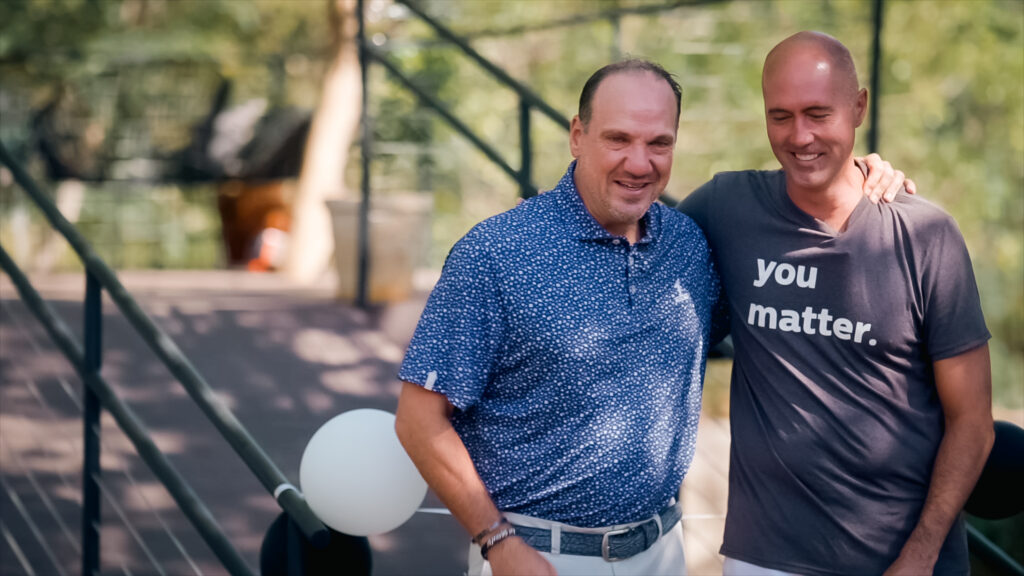
Dan Fagan and MATTER CEO, Quenton Marty
The Missing Middle
There is a name for the financing gap these entrepreneurs were experiencing: the missing middle.
At one end of the market is microfinance, an important economic development tool that can help an individual launch a very small enterprise. But the amount of capital available through microfinance often reaches a ceiling long before a growing business does.
At the other end are larger investment funds, which are generally looking for companies capable of absorbing investments of several hundred thousand dollars or more.
Between those two sits a broad group of small and medium-sized enterprises (SMEs) that do not fit neatly into either category.
They may need $30,000 to purchase equipment that doubles production. Or $75,000 to expand a facility and hire a new team. Or $150,000 to enter a new market where demand already exists.
For a business at that stage, access to the right amount of capital at the right time can determine what happens next. Without it, a company can remain stuck at roughly the same size for years, even when the demand, talent, and opportunity are there.
The Basa Fund was created for that space.
The fund typically invests between $30,000 and $150,000 in high-potential small and medium-sized businesses through a combination of debt and equity. The structure varies by company, but the goal stays the same: help good businesses grow and create jobs.
Why Jobs?
MATTER has spent more than 25 years working alongside communities around the world. Over time, our approach has changed with what we’ve learned. Sometimes a crisis calls for a handout: food, medical supplies, or immediate help when someone needs it most. But lasting change asks us to keep moving. From a handout, to a hand-up through education and opportunity, and ultimately to a handshake between people working as partners. The Basa Fund represents that next step, built on the belief that strong communities are shaped by local people with the ideas, experience, and determination to build their own future.
Through all of that work, one lesson has become increasingly clear to us: one of the best ways to end poverty is to create jobs.
A job changes what a family can count on. There is income coming in next month. School fees can be paid. Food can be purchased. A house can be built. And a family can begin planning beyond the immediate needs of today.
There is dignity in that, too. Work gives people the opportunity to use what they know, develop new skills, contribute to something larger than themselves, and provide for the people they love.
And jobs are created by people willing to take the risk of building businesses.
That is why the Basa Fund measures success beyond the performance of an individual company. We are interested in what happens around that company as it grows. How many people does it employ? What kinds of jobs are created? Can those employees build more stable lives? Does the business begin purchasing more from local suppliers? Does someone who learns a trade there eventually start something of their own?
A growing business creates jobs, strengthens families, and can help transform an entire community.

Capital Is Only Part of the Equation
Of course, putting money into a company does not guarantee that company will succeed.
Growth creates its own set of challenges. A founder who has learned how to run a business with five employees may suddenly be managing fifteen. More customers mean more inventory, more cashflow, more complicated operations, and more decisions with larger consequences.
That is why the Basa Fund pairs investment with business development training through a partnership with Sinapis.
Entrepreneurs receive practical training in financial management, operations, leadership, and the disciplines required to build a healthy company over time. The curriculum is designed for entrepreneurs operating in African markets, so the lessons reflect the realities of running a business there. Capital gives a business the ability to grow. Training helps the entrepreneur manage it well.
The first Basa Fund portfolio invested $230,000 across four companies. The next portfolio is being built with a target of $500,000 across five to seven businesses.
Those numbers are still relatively small, and that is intentional. We are building carefully, learning from each investment, and paying close attention to what produces durable businesses and meaningful jobs.
Ideas Need Believers
The entrepreneurs we meet in Zimbabwe have already built companies, found customers, and created products and services people want. What many still lack is access to the capital to take the next step.
That connects deeply with how MATTER has always approached this work. We believe people are capable of changing their own communities. Our role is to recognize what is already working, stand behind the people building it, and provide the resources that can help their businesses grow.
And somewhere along the way, an entrepreneur who once needed someone to believe in them becomes the person creating opportunity for someone else.
That’s the part we’re most excited to see.