
If you’ve planned a conference in the last few years, you’ve probably felt it: the standard cocktail hour and speed-networking session just aren’t landing the way they used to. Attendees show up, shake a few hands, and check their phones during the “networking break.”
According to PCMA’s Freeman Trends Report, 64% of conference attendees now say that immersive, interactive experiences are the single biggest driver of their overall event satisfaction, not another keynote, not another open bar.
That shift is pushing planners to rethink their conference activation ideas from the ground up. And the data points in a specific direction: charitable activations (structured, hands-on giving-back activities built into the event itself) are outperforming traditional networking and CSR gestures on nearly every metric planners care about, from attendee satisfaction to destination loyalty to sponsor interest.
This post breaks down what the research says about why charitable activations work, walks through real conference activations from associations like NAEC and NGA, and gives you a practical framework for building one into your next event.
Why Event Planners Are Rethinking Traditional Networking
The pressure to change isn’t coming from planners themselves. It’s coming from attendees. As younger professionals take up a larger share of conference rosters, the expectations for what a “good” event looks like have shifted hard toward purpose and participation.
Consider the numbers, compiled by Double the Donation: 88% of Millennials say their jobs feel more fulfilling when their employers provide CSR opportunities, and 93% of employees believe companies should lead with purpose. On the consumer side, 77% of people say they want to purchase from companies with CSR initiatives.
Planners are responding. According to PCMA’s research on planner challenges, 52% of event planners expect to significantly increase CSR initiatives in their meeting agendas going forward. But there’s an important nuance in how attendees want that CSR delivered: 63% of planners prefer to support local community organizations in the host city rather than give to a generic national or international fund. People don’t just want to feel good. They want to see exactly where their effort goes, in the city they’re standing in.
That local, visible, tangible preference is the key that traditional CSR gestures (a donation line item, a sustainability slide in the opening deck) usually miss. It’s also exactly what well-designed conference activations are built to deliver.
What Makes a Conference Activation Idea Actually Work
Not every CSR add-on succeeds. MPI’s research on convention CSR programs points to a few recurring failure patterns that are worth naming before we get to what works:
- Bolting CSR onto the agenda as an afterthought instead of designing it around the event’s core purpose early on in the planning process.
- Burying the activity in a low-traffic pre-conference slot or a remote corner of the venue.
- Forcing a tradeoff between attending the activation and attending core educational content, which guarantees low turnout.
- Skipping the local connection, so the activity feels like a symbolic gesture rather than something with real stakes.
If you’re wondering how to add CSR to a trade show without running into these traps, the fix isn’t complicated. It’s about treating the activation with the same scheduling and logistical seriousness as a headline keynote, not as a side event.
Conference Activation Ideas Backed by Attendee Psychology
Here are five conference activation ideas that hold up under the research, along with the specific psychological or behavioral mechanism that explains why each one works.
Turnkey charitable packing activations.
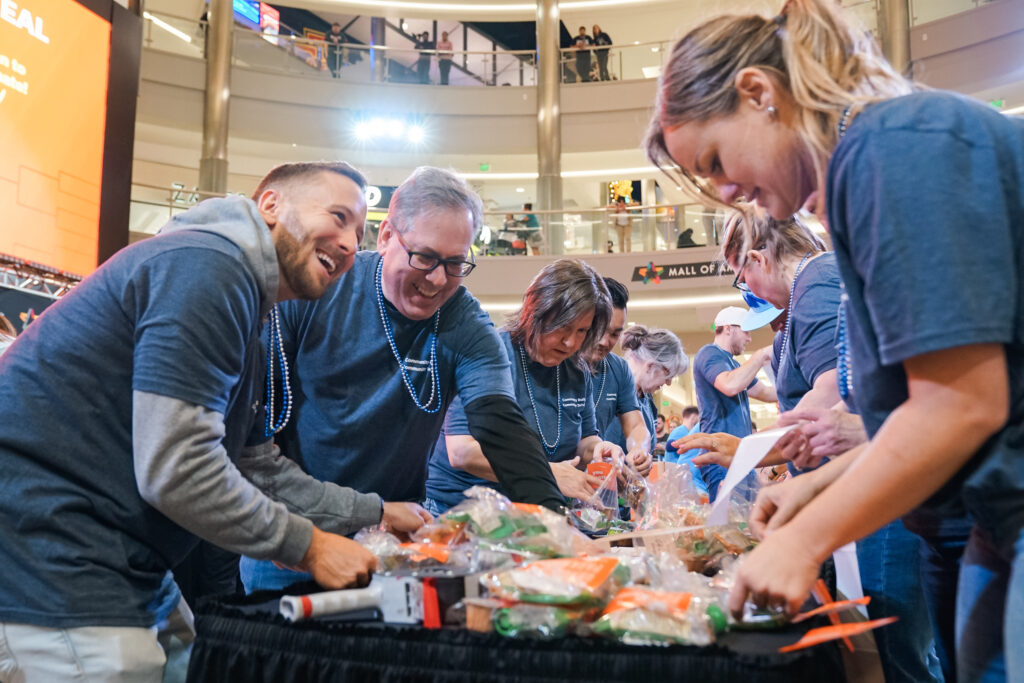
Programs like MATTER’s MATTERbox model (where attendees assemble Snack Packs for food-insecure families or Hope Kits for people facing housing instability) solve the single biggest historical barrier to CSR at conferences: logistics. Instead of bussing attendees off-site to a food bank (expensive, time-consuming, and prone to high no-show rates), the activity comes to the convention floor. It requires about two feet of table space per participant and scales from a 10-person board meeting to a 1,000+ person trade show floor.
Why it works: Research on the Extended Model of Goal-Directed Behavior shows that when an event visibly aligns with attendees’ personal moral values, it directly increases their intention to participate and engage, not just in the activation, but in the event as a whole.
Post-keynote inspiration to action.
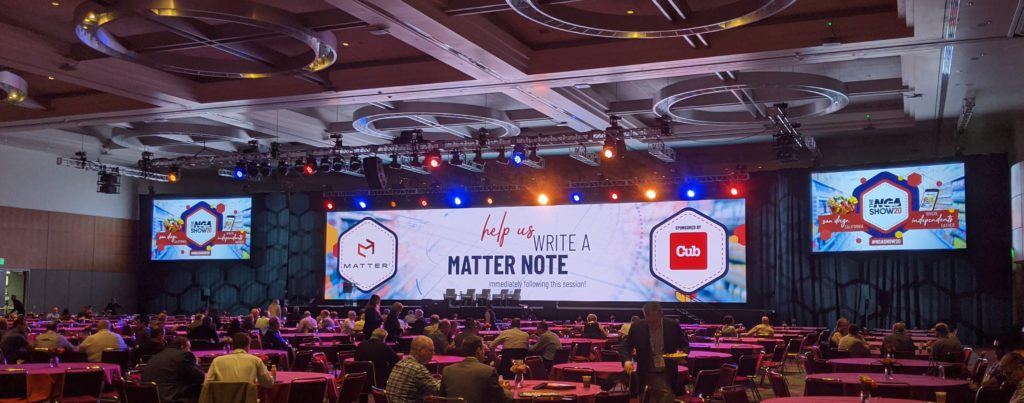
The National Grocers Association (NGA) Show scheduled its MATTERbox packing event immediately after the opening keynote, turning the emotional momentum of the keynote into immediate physical action. Attendees packed over 1,000 snack packs for the San Diego Food Bank in that window.
Why it works: This captures attendees at peak inspiration and gives them somewhere to put it, rather than letting keynote energy dissipate during a generic coffee break.
High-traffic exhibition floor activations.
At the National Association of Elevator Contractors’ “United in Deed” activation, the charitable packing event wasn’t tucked away. It was placed during a dedicated afternoon block on the main floor. Over 100 attendees packed more than 5,000 snack kits for the Boys & Girls Clubs of Greater Houston in under two hours.
Why it works: Research on self-construal and business event attendance explains part of the effect here: a shared physical task neutralizes the usual hierarchy and sales pressure of a trade show floor. Direct competitors and buyers ended up working side by side, having the kind of unguarded conversation that a badge-scan networking hour rarely produces.
Sponsor-backed activations.
Both the NAEC and NGA activations were fully underwritten by corporate sponsors (MEI Total Elevator Solutions and Cub Foods, respectively). Sponsors gravitate toward these activations because they’re visible, photogenic, and universally well-received: a much easier sell than a generic banner ad on the trade show floor.
Why it works: This isn’t a psychology principle, it’s a budget one, but it matters. Sponsorship interest means planners can offer a high-impact activation at little or no net cost to the event budget.
Hands-on, tactile learning breaks.
Conferences routinely subject attendees to eight-plus hours of passive lecture content per day. Cognitive Load Theory tells us this format leads to steep drop-offs in attention and retention. A tactile activity (standing up, moving, using fine motor skills to assemble something) gives the brain a genuine reset.
Why it works: Attendees who take a kinesthetic break in the middle of a dense agenda return to subsequent sessions measurably more able to absorb complex material, which means the activation isn’t just a nice-to-have, it’s protecting the educational ROI of the rest of your program.
Case Studies: Conference Activations in Action
NAEC “United in Deed” (Houston, TX)
“In just under two hours, more than 100 conference attendees worked in tandem to pack over 5,000 healthy snack kits destined for the Boys & Girls Clubs of Greater Houston.”
The bigger win wasn’t the volume. It was what happened on the floor. Direct competitors and enterprise buyers stood shoulder to shoulder, and the usual “pitching” pressure of a trade show evaporated. That’s a hard thing to engineer with any traditional networking format. (Source: MATTER, “How to Build a Business Case for Purpose-Driven Engagement”; EventCreate event listing)
NGA Show (San Diego, CA)
“Attendees enthusiastically pack[ed] over 1,000 snack packs explicitly designated for the San Diego Food Bank.”
This activation worked because it was thematically obvious: an association of independent grocers packing food donations is a perfect match between industry identity and charitable cause. NGA leadership noted that giving back to local communities is already part of the independent grocer ethos, and the activation didn’t feel like an add-on, it felt like an extension of who the attendees already were. (Source: Perishable News; MATTER, “MATTERbox Packing Partnership: 2020 NGA Show”)
The Research Behind Why Charitable Activations Beat Traditional CSR Events
There’s a real academic backbone to all of this, and it’s worth understanding if you need to build a business case internally.
Researchers studying tourist and event well-being distinguish between two types of satisfaction: hedonic well-being (pleasure, such as a good meal, an entertaining keynote, or a nice venue) and eudaimonic well-being (meaning, or the sense of contributing to something larger than yourself). Most conferences are built almost entirely around hedonic offerings. But the literature is clear that eudaimonic well-being produces deeper, more resilient satisfaction, and it’s the kind of satisfaction that turns into brand loyalty, positive word-of-mouth, and repeat attendance.
That last point matters more than it might seem. When attendees know their effort at your conference directly fed local kids or supplied hygiene kits to people in the host city, they form a real connection to that place. That connection is a big part of why they come back next year, even if the conference moves to a different destination.
There’s a neurological layer here too. Traditional networking is transactional: attendees are angling for leads, jobs, or visibility, which can trigger the “overjustification effect”, where external pressure crowds out genuine connection. Prosocial behavior works the opposite way: shifting attention outward, toward a beneficiary, lowers social anxiety and triggers oxytocin and dopamine release, the same neurochemical response associated with trust-building and stress reduction. Attendees leave the activation having networked, but without the exhausted, performative feeling that a forced icebreaker often produces.
Steps to Implement an Impactful Charitable Activation at Your Next Conference
If you’re ready to build one of these conference activation ideas into your event, five best practices show up consistently across the case studies:
- Align the cause with your industry. NGA’s food-focused activation worked because it matched the identity of independent grocers. Look for the natural overlap between your attendees’ work and a local need.
- Schedule it at a high-traffic moment. Put it right after a keynote or in the middle of a prime networking block, not in a pre-conference slot or a remote breakout room.
- Donate locally. Attendees can tell the difference between a real local impact and a symbolic gesture. Distributing to a named, credible local organization (a specific food bank, a specific shelter) makes the impact feel real.
- Pitch it to sponsors first. These activations are highly attractive to sponsors looking for visible, positive brand association. Use that to fund the activity at no cost to your budget.
- Measure and report back. Track hard numbers (boxes packed, meals donated, volunteer hours) and soft numbers (satisfaction scores, qualitative feedback), then report the results back to attendees after the event to reinforce the impact they made.
These same principles apply whether you’re looking for broader attendee engagement ideas for trade shows or a more focused conference volunteer activity idea for a smaller meeting. The scale changes, but the structure doesn’t.
FAQ
What is a charitable activation at a conference?
A charitable activation is a structured, hands-on philanthropic activity built directly into a conference agenda (such as packing snack kits or hygiene kits for a local charity) designed to be completed on-site during the event rather than requiring attendees to travel off-site.
How do CSR activities improve attendee engagement at trade shows?
CSR activities shift attendee focus away from transactional networking and toward a shared, purpose-driven task. Research shows this lowers social anxiety, increases authentic peer-to-peer conversation, and improves overall event satisfaction, particularly among younger professionals who prioritize purpose-driven experiences.
What is the best time to schedule a conference activation?
The most successful conference activations happen during high-traffic moments: immediately following a keynote address or during a dedicated block on the main exhibition floor, rather than in low-attendance pre-conference slots or optional breakout sessions.
Do charitable activations cost extra for event organizers?
Not necessarily. Charitable activations are highly attractive to corporate sponsors because of their visibility and positive brand association, which often means the entire activation is underwritten by a sponsor at no net cost to the event budget.
How do you measure the success of a conference CSR activity?
Track quantitative metrics like the number of kits packed, donations generated, and volunteer hours, alongside qualitative metrics such as post-event attendee satisfaction scores and feedback on the quality of networking the activation facilitated.
Bring a Charitable Activation to Your Next Conference
Attendees aren’t asking for another cocktail hour. They’re asking for something that matters. A well-placed, well-partnered charitable activation gives them exactly that, while giving your event measurable gains in engagement, sponsor interest, and destination loyalty.
MATTER’s MATTERbox program is built to make this simple: turnkey logistics, minimal space requirements, and a track record with associations like NAEC and NGA. Learn how to bring a MATTERbox activation to your next event!